
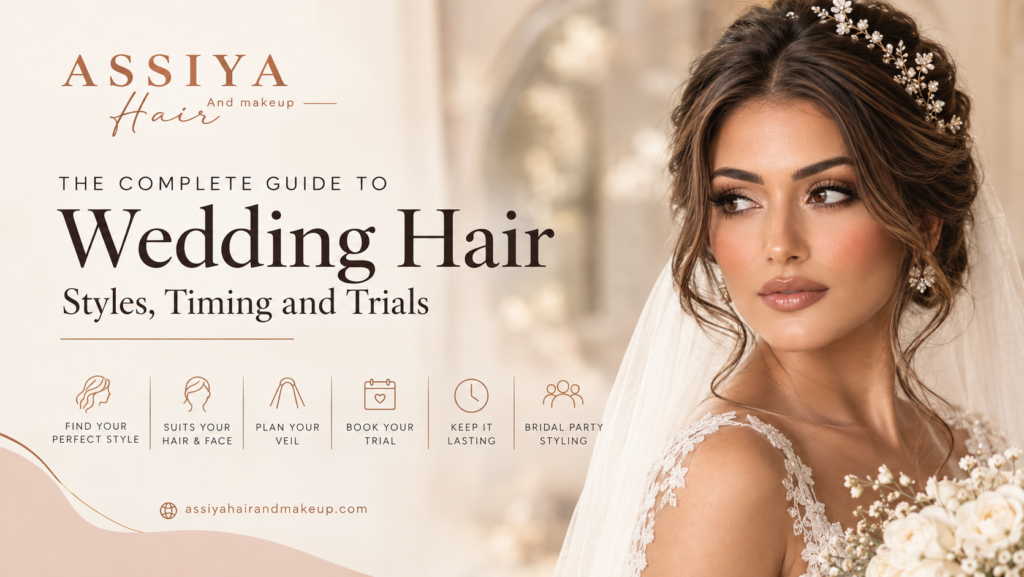
Choosing your wedding hairstyle is one of those decisions that feels bigger than it is, mostly because there are so many options and so many opinions. This wedding hair guide breaks the whole process down: how to pick a style that actually suits you, when to book a trial, and what it takes to keep your hair looking as good at midnight as it did at the ceremony.
Whether you already have a Pinterest board of updos or you’re starting from nothing, here’s everything you need to plan your bridal hair with confidence.
Choosing a Style for Your Hair Type
Not every style works with every hair type, and knowing this early saves you from falling in love with a look that fights your natural texture.
- Fine, straight hair holds curls and volume for a shorter window and often benefits from texturising products and a style with some structure (a braided element or a low, textured bun) to help it last.
- Thick or coarse hair can carry bigger, more voluminous looks well, but may need extra time to curl or smooth, and heavier pins or grips to hold an updo in place.
- Curly or coily hair can be styled beautifully into its natural texture (a curly updo, a half-up look that shows off the curl pattern) rather than fighting it into something it isn’t built for.
- Fine or thinning hair often benefits from strategic backcombing at the crown and hairpieces or extensions for extra volume, rather than relying on styling alone.
Bring your hair’s natural behaviour into the conversation early. An experienced stylist will work with your texture, not against it, and will usually suggest a style during your trial rather than before ever seeing your hair in person.
Matching Your Style to Your Face Shape
Face shape plays a genuine role in which styles look most balanced in photos, though it’s a guide, not a rule:
- Round faces often suit styles with height at the crown and some length or softness framing the jaw, like a soft low bun with face-framing pieces.
- Long or oval faces can carry most styles well, from sleek low buns to fuller, voluminous curls.
- Square or angular faces tend to soften beautifully with waves or curls that fall near the jawline, breaking up strong angles.
- Heart-shaped faces often suit styles that add width lower down, like a textured low updo or waves that sit at the shoulder.
If you’re unsure, bring two or three contrasting reference photos to your consultation rather than a single fixed idea. Seeing a couple of options on your actual face and hair makes the decision far easier than imagining it.
Styling Around Your Veil
If you’re wearing a veil, it needs to be part of the styling conversation from day one, not an afterthought at the trial.
- Where the veil attaches changes what’s possible underneath it. A veil pinned high at the crown needs a different base structure than one attached lower at the nape.
- Cathedral and chapel-length veils tend to pair well with more classic, structured styles, since they’re doing a lot of the visual work themselves.
- Removing the veil for the reception is common and worth planning for. Ask your stylist to build the hairstyle so it still looks finished and intentional once the veil comes out, not like something is missing.
- Bring the actual veil to your trial, not a similar one or a photo of it. Attachment points and weight vary enough between veils that this genuinely changes the outcome.
Updo Versus Hair Down: Which Is Right for You?
This is one of the most common sticking points, and there’s no universally “better” choice, only what suits your dress, venue and comfort.
| Consideration | Updo | Hair Down / Half-Up |
| Formal, structured dress necklines | Tends to balance well | Can compete visually |
| Outdoor or windy venues | Holds up better | More movement, may need extra pinning |
| Long ceremonies and dancing | Very durable through the day | Can lose shape by evening without touch-ups |
| Highlighting a statement back or neckline | Shows off the dress detail | Can cover it |
| Comfort with hair off the neck | Preferred by many brides in warmer months | Preferred by brides who dislike tight styles |
A half-up style is a genuinely good middle ground if you’re torn: it gives you the polish of an updo with some of the softness of hair worn down, and it photographs well from most angles.
What Happens at Your Wedding Hair Trial
A trial is where theory meets your actual hair, face and dress details, and it’s the single most useful step in this whole process.
At your trial, plan to:
- Bring your veil, any hair accessories, and photos of your dress neckline and back detail.
- Wear your hair as close to how it’ll be on the day (freshly washed the day before, not the morning of, is usually recommended).
- Take photos from the front, side and back, and in both natural light and warmer indoor lighting.
- Test how the style holds by moving around, sitting down, and giving it a gentle shake rather than staying perfectly still.
Book your trial somewhere between four and eight weeks before the wedding, ideally once you’ve had any planned haircut or colour change, so what you trial is what you’ll actually be wearing on the day. [ASSIYA INPUT NEEDED: confirm the typical trial booking window Assiya recommends, and whether the hair trial is usually done alongside the makeup trial or as a separate appointment.]
Making Your Hairstyle Last All Day
Sydney weddings bring genuine longevity challenges, particularly humidity through the warmer months and long outdoor ceremonies, so the styling technique matters as much as the final look.
- Clean, second-day hair (not freshly washed the morning of) generally holds curl and pins better than freshly washed hair, which can be too slippery to grip.
- The right pins and grips for your hair’s thickness make a bigger difference than any single product; too few pins is the most common cause of a style dropping early.
- A strong-hold finishing spray, applied in sections rather than one heavy blast at the end, protects against humidity without leaving hair stiff.
- A small touch-up plan for the day, such as extra pins tucked into a bridesmaid’s clutch, covers you for any last-minute adjustments after photos or during an outdoor ceremony.
If your wedding is outdoors or in a particularly humid month, mention this when you book so your stylist can plan the technique (and hold-level products) around it in advance, rather than reacting to it on the day.
Styling the Bridal Party
Most bridal hair bookings extend to the full party, and coordinating this well is part of what keeps the morning running smoothly.
- Bridesmaids don’t need to match the bride’s exact style; complementary but distinct looks (same general polish level, different details) usually photograph better than identical hairstyles on different face shapes.
- The mother of the bride and groom often prefer more classic, low-maintenance styles that suit their hair length and comfort level.
- Flower girls typically need simpler, faster styles, both for time and for comfort with younger, more fidgety clients.
- Confirm styling order in advance (often by who needs the most time or is leaving earliest for photos) so the whole party stays on schedule.
Bringing It All Together
Your wedding hairstyle comes down to a handful of decisions made well in advance: a style that suits your hair type and face shape, a plan for your veil, a clear call on updo versus down, and a trial booked early enough to get it exactly right. Get those right, and the styling on the morning itself becomes the smooth, enjoyable part of getting ready.
If you’re ready to lock in your date, take a look at our wedding hair services for full details, browse real looks in the gallery, or get in touch to check availability.
Frequently Asked Questions
How far in advance should I book my wedding hair trial?
Four to eight weeks before the wedding is the usual window, ideally after any planned haircut or colour change so your trial reflects exactly what you’ll be wearing on the day.
Should I wash my hair the morning of the wedding?
Generally, no. Clean, second-day hair holds curl and pins better than freshly washed hair, which tends to be too slippery for a style to grip properly.
Can I change from an updo to hair down for the reception?
Yes, this is a common request. Let your stylist know in advance so the initial style is built in a way that transitions cleanly once any pins or the veil come out.
What if my venue is outdoors and it’s humid?
Mention this when you book. The right pinning technique and hold-level products can be planned around humidity in advance, rather than trying to fix it once you’re already there.